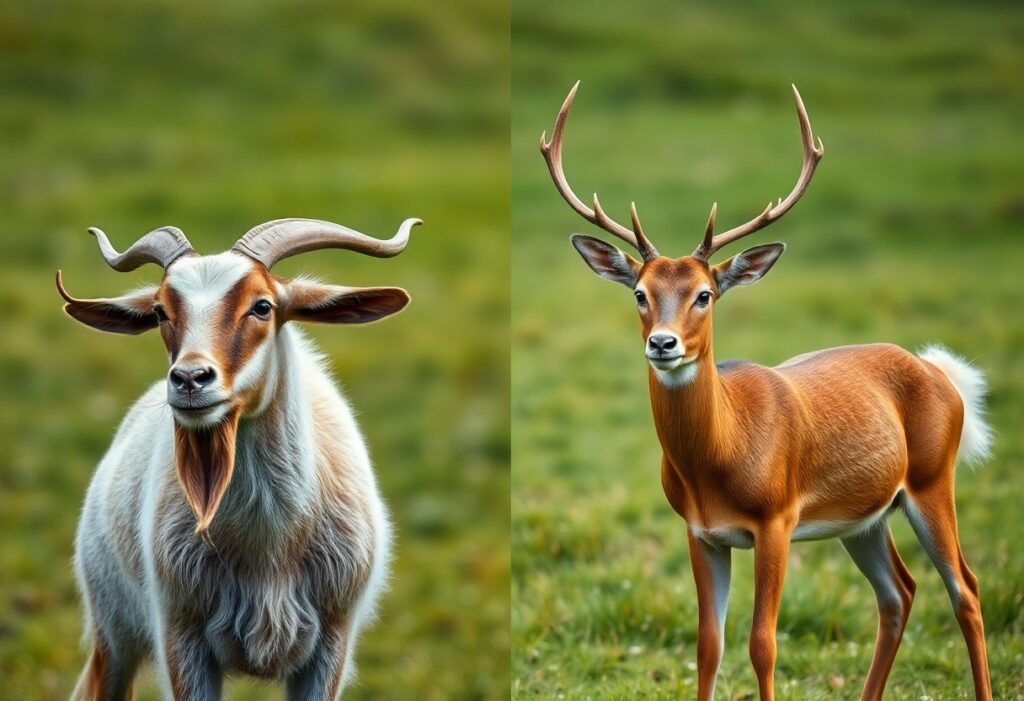
Over your morning coffee, you spot a small herd near your fence line, and you wonder-am I looking at goats or deer? While both animals may graze on your property, knowing the difference can protect your landscaping and prevent unexpected encounters. Goats are more likely to chew shrubs down to the stem, while deer tend to nip cleanly and move on. Recognizing which animal is visiting helps you choose the right deterrents and fencing. This guide walks you through five clear visual cues to tell them apart, starting with the shape of their heads and ending with how they look back at you.
Observations on the Crown
When you look at the top of the head, goats often have a slightly dished or concave profile between the eyes and nose, giving their crown a subtle indentation. Deer, in contrast, typically show a straight or gently sloping facial line from forehead to nose, creating a more streamlined silhouette. Some goat breeds also carry small tufts of hair on the chin or under the jaw, which can extend the visual shape of the head. This distinction becomes especially clear at a distance when lighting highlights the contour of the skull and muzzle.
The Quality of the Pelage
Your eye might catch the texture of their coats before anything else. Goats typically have coarse, straight guard hairs with a minimal undercoat, giving them a sleeker, sometimes shaggy appearance in certain breeds like the Siberian. In contrast, deer sport soft, dense fur that often feels woolly beneath the outer layer, especially in cooler months. This difference becomes especially noticeable up close or in photos, where the goat’s wiry hair reflects light differently than the deer’s velvety pelage.
The Proportions of the Frame
Goats tend to have a more compact, boxy build with straighter backs and shorter legs relative to their body, giving them a sturdy, almost rectangular outline. Deer, in contrast, appear more elongated and graceful, with longer legs and a sloped back that creates a distinctly athletic silhouette. If you spot an animal that looks like it’s built for quick bursts through brush or leaping over fences, it’s far more likely to be a deer. A backyard visitor standing about 30 inches at the shoulder with a level topline? That balanced frame often points straight to a goat.
The Carriage of the Tail
You’ll notice goats often hold their tails upright, especially males, with a slight curl or tilt that can look almost perky. Deer, in contrast, typically carry their tails down or tucked, though some species like white-tailed deer flash a raised, bushy tail when alarmed. This difference is most obvious when the animal is at rest or moving casually through your property.
The Nature of the Gaze
Goats often lock eyes with you in a way that feels almost inquisitive, their rectangular pupils giving them a wide field of vision and a distinctly intense stare. Deer, on the other hand, tend to glance sideways or over their shoulder, relying on peripheral awareness to detect movement. That sideways glance from a deer is often your first clue it’s nearby, especially at dawn. Their eyes are set farther to the sides of the head, enhancing escape responses, while a goat’s forward-facing focus suggests curiosity, even boldness, when near fences or structures.
Conclusion
You can now tell goats and deer apart with confidence, just by noticing a few key details. Spotting the shape of the horns, the texture of the coat, or how the animal holds its tail gives you clear clues. A goat in your backyard likely has upright pupils and a scruffy beard, while a deer slips quietly through the trees with soft eyes and a flicking tail. These small signs make all the difference.
FAQ
Q: How can I tell if an animal near my property is a goat or a deer based on its horns?
A: Goats and deer differ significantly in horn structure. Domestic goats typically have horns that grow upward and slightly backward, often with a curved or corkscrew shape, especially in breeds like Kiko or Nubian. These horns are permanent and made of keratin over a bony core. Deer, on the other hand, grow antlers annually, usually in a branching pattern that extends forward and upward from the forehead. Male white-tailed deer, common in many rural and suburban areas, shed and regrow their antlers each year, while female deer generally lack antlers entirely. If you spot a horned animal with symmetrical, multi-pointed growths that look like they’ve been shed recently, it’s almost certainly a deer.
Q: Do goats and deer move differently when walking near fences or wooded areas?
A: Yes, their movement patterns reflect their distinct body plans and behaviors. Goats tend to walk with a more upright posture, often balancing on narrow surfaces like logs or low walls with deliberate, surefooted steps. A goat might stand still and stare, especially if curious about human activity. Deer move with a lighter, springier gait, their heads bobbing slightly with each step. When startled, a deer typically bounds away in a stiff-legged leap called stotting, lifting all four feet off the ground at once. Goats rarely flee this way, instead choosing to climb or retreat slowly while keeping an eye on the disturbance.
Q: Can the sound an animal makes help identify whether it’s a goat or a deer?
A: Vocalizations offer a reliable clue when visual identification is difficult. Goats are notably vocal, especially does calling to kids or bucks during breeding season. The familiar “baa” or bleating sound-sometimes loud and persistent-is a strong indicator of a goat, particularly near dawn or dusk. Deer are generally quiet, though they may make soft grunts, snorts, or bleats, especially fawns calling for their mothers. A high-pitched, repetitive bleat echoing near a pasture or shed is almost always a goat, while a sudden snort from the edge of the woods likely comes from a startled deer. A mid-sized SaaS firm might use motion-triggered audio sensors to log such sounds, but even casual observation over a few days can reveal these patterns clearly.