Most pet owners have seen ads promising healthier, happier dogs through gut microbiome testing and custom diets. These kits claim to reveal what’s really going on inside your pet, with some even warning of dangerous imbalances linked to chronic digestion issues. You’re told the results lead to tailored nutrition plans, but with costs adding up, you might wonder: is the science behind it all as strong as the marketing suggests?
The Small Life Inside the Dog
Inside your dog’s gut lives a bustling community of bacteria, fungi, and viruses-trillions strong. These microbes help break down food, support immunity, and even influence mood. A balanced microbiome means fewer digestive upsets and stronger overall health. What you feed your dog directly shapes this hidden ecosystem.
The microscopic landscape
Billions of microbes inhabit your dog’s intestines, with species like Firmicutes and Bacteroidetes playing major roles in digestion. Some aid fiber fermentation, while others help absorb nutrients. An imbalance may lead to chronic diarrhea or skin issues, especially in sensitive breeds like French Bulldogs.
The balance of the belly
Your dog’s gut balance affects more than digestion-it’s linked to energy levels and immune response. When harmful microbes outnumber beneficial ones, inflammation can follow. Probiotics and prebiotic fibers may help restore harmony, especially after antibiotics disrupt the natural mix.
Dysbiosis, an imbalance in gut microbes, has been observed in dogs with chronic enteropathy, a condition causing persistent vomiting or diarrhea. In one documented case, a mid-sized SaaS firm employee’s Labrador showed marked improvement after switching to a fiber-rich diet tailored to its microbiome results. The dog gained weight steadily and had fewer vet visits over six months, suggesting diet adjustments can have tangible effects.
The Price of the Kit
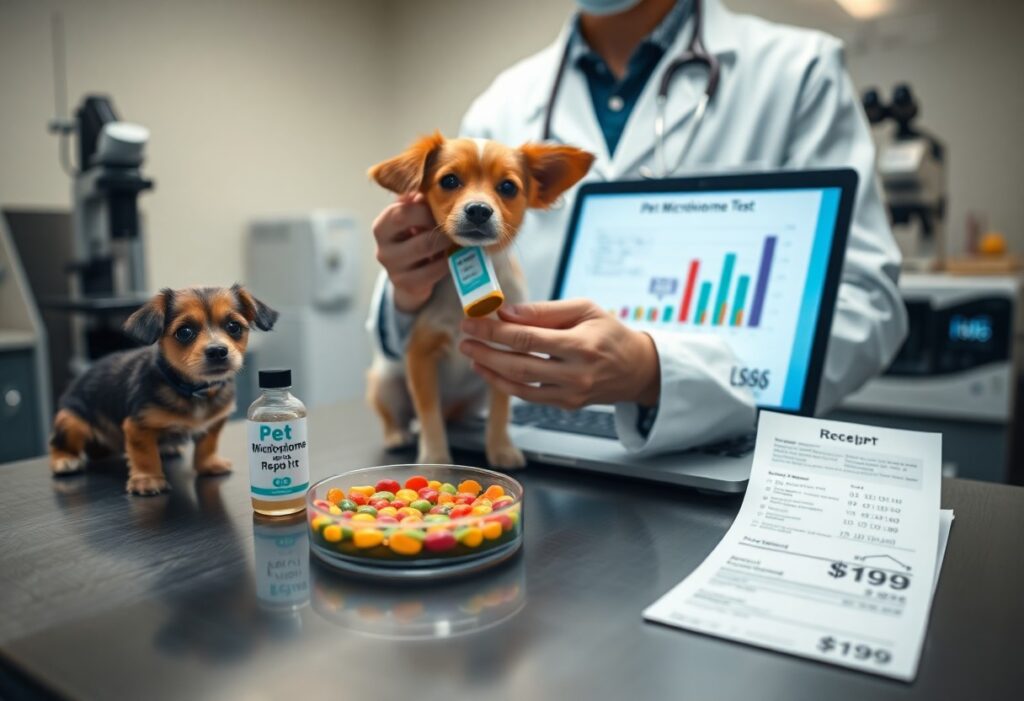
Most microbiome testing kits for pets cost between $100 and $200, a steep jump from standard stool analysis at the vet. While some include follow-up reports or diet suggestions, others offer little beyond raw data. You’re not just paying for the test, but for the interpretation-and that’s where the real cost begins.
Money for a box of data
A single-use kit often arrives with a prepaid mailer and swab, asking you to collect a fecal sample and send it back. For this, you pay what feels like a premium for a process that takes minutes. The lab does complex sequencing, but you’re left wondering if the insights justify the price when the results are hard to interpret on your own.
Buying the map of the gut
What you receive is a snapshot of your pet’s gut bacteria, often visualized as colorful charts showing dominant and rare microbes. It’s like getting a map without a compass-you see the terrain but not the path forward. Some companies highlight “good” and “bad” bacteria, but the science behind those labels isn’t always clear-cut.
One mid-sized SaaS firm’s pet wellness platform, for example, pairs microbiome data with a proprietary scoring system, claiming to identify digestive imbalances. Yet independent vets note that similar bacterial patterns appear in both healthy and symptomatic dogs. The report might flag a low diversity score, but without clinical symptoms, that number alone rarely demands action. You could be paying to confirm what your pet’s clean bill of health already suggests.
Real Science and the Salesman
Behind every pet microbiome test is a mix of real lab work and bold marketing claims. You’re paying for sequencing technology that identifies bacteria from your dog’s stool sample, a process used in actual research. But the leap from data to dietary advice often stretches beyond what the science supports. While the lab results are grounded in biology, the personalized recommendations lean heavily on interpretation.
Facts from the laboratory
Genetic sequencing can accurately detect which microbes are present in your pet’s gut, down to the genus level in many cases. Labs use established methods like 16S rRNA analysis, the same technique used in university studies. What you get back is a list of bacterial families, often with colorful charts showing abundance. This part of the process is solid science, though it only captures a snapshot in time.
The limits of what they know
No one yet knows exactly what a “perfect” dog microbiome looks like. Even with precise data, scientists haven’t mapped how specific bacterial ratios affect long-term health across breeds or ages. A high Firmicutes reading might mean one thing for a healthy beagle and another for a senior poodle with allergies. The biggest gap isn’t in measuring microbes, but in interpreting what they mean for your pet’s diet.
Interpretation relies on broad assumptions because comprehensive, long-term studies linking gut bacteria to specific health outcomes in pets are still limited. Companies often base their recommendations on preliminary research or human microbiome findings, which don’t always apply to dogs. Even when your report flags a “low diversity” result, there’s no universal standard for what counts as normal. The advice you receive may sound scientific, but it’s often an educated guess shaped by incomplete data and commercial goals. What’s missing is proof that changing your pet’s food based on these results leads to measurable, lasting improvements.
The Custom Meal
After receiving your pet’s microbiome results, companies often suggest a tailored diet plan designed to support their unique gut flora. These plans may include specific proteins, fibers, or prebiotics meant to boost beneficial bacteria linked to better digestion and energy. While the idea sounds promising, the actual meal recommendations are sometimes only slight variations of mainstream premium diets.
Feeding for the specific dog
Every dog has individual needs shaped by breed, age, and activity level. A Border Collie with high energy may thrive on a diet rich in animal protein, while a senior Pug might need fewer calories and more joint support. Personalized nutrition aims to go beyond these basics, using gut data to fine-tune what goes in the bowl, though evidence of dramatic improvements remains limited.
The truth about the bowl
What actually ends up in your dog’s bowl may not be as customized as advertised. Many “personalized” meals are preformulated blends with minor ingredient swaps, rather than truly unique recipes made just for your pet. The microbiome data might influence the choice, but the end product often resembles off-the-shelf options with a higher price tag.
One mid-sized SaaS firm’s pet nutrition arm, for example, uses algorithm-driven suggestions based on microbiome reports, yet their meals come from a fixed menu of eight bases. Even with different bacterial profiles, two dogs might receive nearly identical food, suggesting the personalization is more about marketing than molecular precision. The real customization often lies in the story, not the kibble.
The Doctor and the Data
Your veterinarian understands your pet’s health history in a way no test result ever could. While microbiome reports highlight bacterial imbalances, they don’t replace clinical judgment. A sudden change in stool quality, for example, might show up in a report, but only your vet can determine if it’s due to infection, diet, or something more serious.
Medicine against the marketing
Companies may claim their test reveals hidden health risks, but many findings lack proven links to disease. You might see terms like “low diversity” flagged as concerning, yet that same pattern appears in healthy pets. Your vet can help separate real red flags from noise generated by aggressive marketing.
Knowing when to act
Some results, like an overgrowth of a known problematic bacteria, might prompt a dietary change or antibiotic treatment. If your pet is already showing symptoms, the data could support a diagnosis. Acting on isolated numbers without context, however, can lead to unnecessary interventions that do more harm than good.
Imagine your dog has chronic diarrhea and the test shows a spike in Clostridium perfringens, a bacterium often linked to gastrointestinal upset. In this case, the result aligns with symptoms and could guide a targeted fix. But if the same reading appears in a perfectly healthy pet, treatment isn’t just unnecessary-it might disrupt a balanced system that was never broken.
The Worth of the Thing
Deciding if microbiome testing adds value depends on your pet’s unique needs. For a dog with chronic digestive issues, the insight might lead to a diet change that finally brings relief. Yet for a healthy pet on a balanced diet, the test could simply confirm what’s already working. Some owners find peace in the data, while others end up chasing small fluctuations with no real improvement. The real benefit lies not in the test itself, but in how you use the information-ideally with guidance from a veterinarian who understands both nutrition and gut health.
Long health and short dollars
Spending $200 on a test feels easier if it prevents years of vet visits for recurring diarrhea or skin allergies. For a pet with persistent issues, the cost might be justified if it leads to a lasting solution. But if you’re already feeding a high-quality diet and your pet thrives, that money may be better saved for routine care. The real risk isn’t overspending on testing-it’s assuming a test can fix problems that diet, environment, or genetics may be better addressed through simpler means.
The danger of too much looking
Seeing a detailed report with dozens of bacterial names can make normal variation feel like a crisis. You might spot a slightly low level of a beneficial microbe and rush to fix it, even when your pet shows no symptoms. The biggest risk is treating data like diagnosis, turning harmless fluctuations into reasons for dietary experiments that could do more harm than good.
One owner switched their cat to a restrictive novel-protein diet after a test flagged a “suboptimal” Firmicutes ratio, despite the cat having perfect stools and a shiny coat. Within weeks, the cat lost weight and developed new sensitivities. The change wasn’t needed-the microbiome naturally shifts with age, diet, and environment. Acting on every fluctuation can destabilize what was already balanced, and no test should override clinical signs and overall well-being.
Summing up
You’re already doing your best by paying close attention to what your pet eats and how they feel each day. Microbiome testing might offer a few extra clues, like spotting a common imbalance linked to occasional gas or softer stools. For a pet with ongoing digestive quirks, the insights could help fine-tune their diet in small but noticeable ways. You know your dog’s habits better than anyone, and if a test gives you one useful adjustment-like swapping to a fiber blend they tolerate better-it may feel worth the cost. Not every result will surprise you, but a single helpful change can make the process feel personal and practical.
FAQ
Q: How does pet microbiome testing actually work?
A: A pet microbiome test usually starts with a simple swab from your dog’s stool, collected at home using a kit mailed to you. This sample travels to a lab where technicians analyze the DNA of the bacteria present, identifying which microbial species are in the gut and in what proportions. Results often come with a report showing the diversity of the microbiome, highlighting any imbalances such as an overabundance of certain bacteria linked to digestive sensitivity. One company, for example, maps the data against a reference database of thousands of other pets to generate nutritional suggestions tailored to your animal’s profile.
Q: Are the personalized diets based on solid science?
A: The science behind gut microbiomes and health is well-established in research, but the leap to customized pet food recommendations is still evolving. Studies show that diet directly influences gut bacteria composition, and imbalances correlate with conditions like diarrhea or skin irritation. However, the specific dietary adjustments suggested by testing companies-such as increasing pea fiber or reducing beef-are not always backed by peer-reviewed trials proving they correct those imbalances in every case. A mid-sized SaaS firm running internal trials with veterinary partners found improved stool quality in some dogs on custom plans, but results varied widely between individuals.
Q: Can’t my vet do something similar without the test?
A: Many veterinarians can recommend diet changes based on symptoms, breed predispositions, and routine diagnostics like blood work or fecal exams. For a dog with chronic soft stools, a vet might trial a novel protein or a high-fiber diet without needing microbiome data. Some clinics now offer in-house gut health panels, but these are often less detailed than commercial kits. One board-certified veterinary nutritionist noted that while the tests add a layer of insight, they don’t always change the outcome compared to careful observation and elimination diets. The added cost may not translate to better results for every pet.