There’s a good chance you’ve seen animals grazing near your property and wondered if they’re goats or deer. Deer can carry ticks that spread Lyme disease, while goats may damage vegetation aggressively. Knowing the difference helps protect your land and health. You can identify them by their movement, horns, and behavior-details this guide will clarify clearly.
Classification and Common Types
Goats and deer differ significantly in biological classification, affecting how they interact with your land. Goats belong to the genus *Capra*, while deer are part of the family Cervidae. Domesticated goats are common in agricultural settings, whereas deer are typically wild. Knowing
| Species Type | Example Varieties |
| Domestic Goat | Kiko, Nubian, Boer |
| Wild Goat Relative | Ibex, Markhor |
| Common Deer | White-tailed, Mule Deer |
| Large Deer Species | Elk, Moose |
Domesticated Goat Breeds for Land Management
You’ll find Boer goats effective for brush control due to their appetite for woody plants. Kiko goats thrive in rugged terrain with minimal care, making them durable for large properties. Some breeds resist parasites better than others. Knowing
Prevalent Deer Species in Rural Environments
White-tailed deer are the most widespread species you’ll encounter on rural land. They browse on young trees and crops, causing significant damage if unmanaged. Mule deer prefer drier, mountainous regions and are less adaptable. Knowing
White-tailed deer adjust easily to changing landscapes, often expanding their range near human activity. These animals are strong jumpers and can breach fences under 8 feet. During mating season, bucks become more aggressive and unpredictable. Their feeding habits can threaten reforestation efforts and garden plantings. Knowing
Primary Identifying Factors
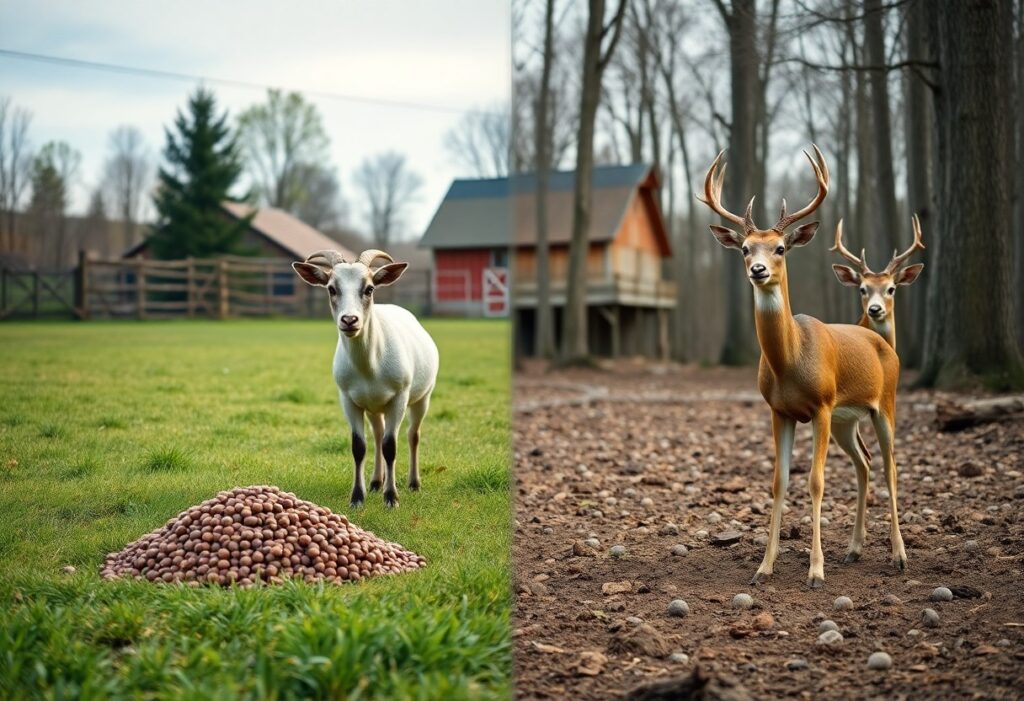
Observing body shape, head structure, and horn configuration helps distinguish goats from deer. Goats typically have beards, upright ears, and curved horns, while deer feature slender muzzles, large ears, and branched antlers.
- Horns in goats are permanent; deer shed antlers annually
- Hoof shape differs: goats have nimble, cloven hooves for climbing
- Deer exhibit a bounding gait; goats move with deliberate balance
Recognizing these traits prevents misidentification and supports proper land management.
Distinctive Physical Anatomy and Horn Growth
Anatomy reveals clear contrasts: goats possess a stockier frame, arched back, and short tail, while deer are leaner with long, horizontal spines. Horn growth in goats follows a consistent curve from the skull, made of keratin over bone. Deer grow antlers from pedicles, which are bony skull extensions. These antlers are deciduous and regenerate each year. Recognizing these differences helps you assess animal presence accurately.
Behavioral Differences and Social Hierarchies
Social patterns set these animals apart. Goats form tight-knit herds with a clear dominance hierarchy, often led by a single female. Males spar using their horns to establish rank. Deer, in contrast, live in matriarchal groups or solitary during certain seasons, with bucks forming loose bachelor groups. Recognizing these behaviors informs how they interact with fences, terrain, and human activity.
Deer respond strongly to seasonal changes, altering movement and social structure with breeding cycles and food availability. Does often lead fawn groups, relying on stealth and stillness to avoid predators. Goats are more confrontational, using elevated terrain to monitor surroundings and defend territory. Their social bonds influence grazing patterns and fence testing. Understanding these dynamics helps you anticipate property impact and design effective deterrents.
Step-by-Step Field Identification Guide
Use this quick-reference table to identify key physical and behavioral traits in the field. Observing these characteristics systematically improves accuracy and prevents misidentification, especially in shared habitats where both species may be present.
| Feature | Goat | Deer |
| Hoof Shape | Narrow, cloven with sharp edges | Broad, heart-shaped, splayed |
| Horns/Antlers | Curved, permanent, both sexes | Branching antlers, males only, shed yearly |
| Tail Position | Upright, flicks when agitated | Lowered, raised when alarmed |
| Shoulder Height | 24-40 inches | 30-48 inches |
Distinguishing Tracks, Scat, and Bedding Areas
Track shape reveals much: goats leave narrow, pointed prints, while deer tracks are wider with a distinct heart shape. Scat from goats is pellet-like and clumped; deer droppings are similar but more scattered. Bedding areas under shrubs with flattened ground often indicate deer, whereas goats prefer rocky outcrops and show signs of browsing at higher levels. Look for hair snagged on brush-a clear sign of frequent use.
Recognizing Vocalizations and Movement Patterns
Sound matters when visibility is low. Goats produce loud, bleating calls, especially during mating or distress. Deer snort sharply when alarmed-a key warning signal near your property. Movement-wise, goats climb steep terrain with agility, often in straight, deliberate paths. Deer bound in zigzags when fleeing, leaving erratic trails through brush.
Deer rely on stealth and sudden bursts of speed, freezing when they sense danger before bolting in a series of leaps. Goats, in contrast, stand their ground on high ground, scanning with keen eyesight. Their social structure means you’ll often hear multiple bleats in sequence, especially from kids. Recognizing these patterns helps you assess presence and potential impact on fencing or vegetation before damage occurs.
Pros and Cons of Species Presence
Understanding the advantages and risks each species brings helps you make informed land-use decisions. Below is a comparison to clarify what to expect from goats and deer on your property.
| Goats clear brush efficiently | They can damage trees by stripping bark |
| Low-cost vegetation management | Require secure fencing to contain |
| Produce milk, meat, or fiber | Potential for overgrazing if unmanaged |
| Adaptable to varied terrain | May carry parasites transmissible to wildlife |
| Active browsers reduce fire fuel loads | Need regular health monitoring |
| Minimal machinery required | Can be noisy and disruptive to neighbors |
| Manure enriches soil naturally | Require shelter from extreme weather |
| Help control invasive plants | May attract predators like coyotes |
| Can increase land productivity | Need water access year-round |
| – | Deer overpopulation leads to crop loss |
Benefits and Challenges of Goat Husbandry
You gain effective land maintenance and potential farm income when raising goats. They thrive on tough plants other livestock avoid, reducing mowing needs. Yet, without proper rotation and fencing, they may degrade soil or harm woody vegetation over time.
Impact and Management of Wild Deer Populations
You face both ecological balance and property damage concerns with deer. They browse native plants and garden crops aggressively, often leading to costly losses. Managing their numbers requires coordinated strategies like regulated hunting or exclusion fencing.
Deer adapt quickly to suburban environments, increasing human-wildlife conflicts. High densities result in overbrowsing, reducing forest regeneration and increasing tick-borne disease risks. You must consider humane, sustainable methods such as fertility control or habitat modification to maintain healthy herd levels without disrupting local ecosystems.
Essential Management Tips for Property Owners
Understanding the differences between goats and deer helps you apply effective containment and forage strategies.
- Use tall, sturdy fencing for deer to prevent jumping
- Install tight-wire grids for goats to block squeezing through
- Rotate grazing areas to protect pasture health
Any oversight in planning can lead to escaped animals or land degradation.
Fencing Requirements and Containment Strategies
Height matters most with deer, requiring fences at least 8 feet tall to deter leaps. Goats need secure horizontal wiring spaced no more than 6 inches apart near the base. Mesh fencing prevents climbing and escape attempts. Any weak point invites trouble.
Sustainable Forage and Nutritional Planning
Rotating grazing zones preserves plant regrowth and reduces soil erosion. Goats thrive on brush and weeds, while deer prefer tender shoots and forbs. Matching their diet to natural vegetation cuts feed costs. Any imbalance risks malnutrition or overgrazing.
Planning your forage strategy around seasonal plant cycles ensures consistent nutrition. Goats are browsers and will strip bark if feed is scarce, causing long-term damage to trees. Deer overconcentrated in one area can eliminate native ground cover. Introducing diverse plant species supports health and sustainability. Any neglect in rotation or stocking density harms both animals and land.
Final Words
Following this guide, you now have the practical knowledge to tell goats and deer apart on your property. You can identify them by their behavior, physical traits, and signs they leave behind. Recognizing these differences helps you manage land use, prevent damage, and support local wildlife responsibly. Your observations make a real difference.
FAQ
Q: How can I tell if an animal on my property is a goat or a deer?
A: Goats and deer have distinct physical features that help in identification. Goats typically have rectangular pupils, upright horns that curve backward, and a short, upright tail that they often hold high. They may also have beards, especially males. Deer have oval or horizontal pupils, antlers that branch outward (in males), and a long, slender tail that hangs down or raises when they run. Deer move with a bounding gait, while goats are more agile on steep or rocky terrain and often stand still to observe their surroundings.
Q: Do goats and deer behave differently around fences and property structures?
A: Yes, their behaviors differ significantly. Goats are natural climbers and often jump over or balance on fences, especially if curious or seeking food. They may chew on wooden posts, fabric, or even electrical cords if accessible. Deer usually avoid climbing and instead leap over fences in a graceful arc. They rarely chew on structures but may rub their antlers on trees or posts during mating season. If you notice damaged fencing with signs of chewing or climbing, goats are more likely the cause.
Q: What kind of damage might each animal cause to my landscaping or crops?
A: Goats are browsers that eat a wide variety of plants, including shrubs, weeds, and ornamental vegetation. They tend to strip leaves and small branches methodically and may knock over small plants while playing or climbing. Deer also browse but prefer tender shoots, flowers, and vegetables. They leave a ragged edge on torn plants because they lack upper front teeth, unlike goats, which have a dental pad and create a cleaner bite. Finding neatly cropped plants suggests goat activity, while shredded stems point to deer.