It’s easier than you think to make training part of play: in this guide you’ll find 10–12 fun tricks to teach your cat that boost your bond and mental health. Using positive reinforcement and short sessions helps shy or older cats progress, while avoiding force, harsh corrections and choking hazards or toxic treats keeps training safe. You’ll get step-by-step basics, treats, timelines and troubleshooting so you can confidently turn interactive playtime into enrichment.
Key Takeaways:
- Start easy with short, daily sessions using clicker training and positive reinforcement—this makes fun tricks to teach your cat approachable: focus on one behavior, reward small steps, and use high‑value, age‑appropriate treats.
- Pick a progressive set of 10–12 tricks (sit, high‑five, come, fetch, spin, jump through a hoop, target touch, lie down, stand, tunnel, paw, heel) and increase distance or complexity as your cat masters each move.
- Training boosts bonding and mental stimulation; if a cat is stubborn, lower criteria, remove distractions, shorten sessions, vary rewards, and celebrate small wins for steady progress.
Understanding Your Cat’s Behavior
The Feline Mind: Why Cats Learn
Cats learn through associative and operant processes: they link actions to outcomes and repeat what pays off. You can harness their natural hunting drive and curiosity—short, high-value rewards speed learning—so when you teach fun tricks to teach your cat, expect most behaviors to show improvement after 5–20 consistent repetitions. Training also reduces boredom and increases mental stimulation, which benefits your cat’s wellbeing and strengthens your bond.
Recognizing Your Cat’s Learning Style
Some cats are food-motivated, others chase toys or crave social praise; identifying which energizes your cat makes training efficient. Test motivators in brief 30–60 second trials—if your cat engages within the first 10 seconds, that’s a strong reinforcer. Adjust session length to 3–5 minutes, and pick rewards that are most enticing to your cat to speed results.
Run a simple experiment: offer a tiny treat, a favorite wand toy, and a few seconds of petting in separate short trials and note response time and enthusiasm. If your cat ignores food but pounces on the wand within 5 seconds, prioritize play-based rewards and use food only as occasional reinforcement. Watch body language—ears back or tail thrashing signals overstimulation, which can lead to defensive bites; stop before frustration escalates.
The Importance of Positive Reinforcement
Positive reinforcement means rewarding desired actions immediately—ideally within one second—so your cat links behavior and outcome. Use tiny, high-value treats (pea-sized bites), clicker markers, or play; avoid punishment, which creates fear and undermines trust. Consistent, upbeat rewards increase the frequency of behaviors and make learning for you and your cat enjoyable.
Start with continuous rewards: give a treat every successful attempt for the first 8–12 repetitions, then shift to an intermittent schedule (reward 50–70% of successes) to build reliability. Keep sessions to 2–4 short bouts per day and gradually replace food with praise or play to maintain motivation while controlling calories. If progress stalls, lower criteria, simplify the task, and reward successive approximations to rebuild confidence.
Preparing for Training
Choosing the Right Environment
Pick a quiet, familiar room with soft lighting and minimal foot traffic so your cat stays focused; aim for sessions when your cat is alert, often 20–60 minutes after a nap. Remove clutter and dangerous items like loose strings, rubber bands, or small objects that could be swallowed. Limit distractions—turn off TV and silence phones—and set a timer for short 3–5 minute bursts to keep training fun and effective for the fun tricks to teach your cat.
Gathering Your Supplies
Assemble a tiny treat stash (pea-sized pieces), a clicker or verbal marker, a target stick, a soft mat, and 1–2 interactive toys like a wand or small hoop. Choose treats with strong smell—freeze-dried chicken or small tuna bits work well—and keep supplies within arm’s reach so sessions flow smoothly; using a clicker increases precision and speeds learning.
For treats, pick options with high palatability and low calories: aim for pieces under about 3 kcal each and offer 2–4 per 3–5 minute session (about 6–12 kcal total). Avoid toxic foods like chocolate, onions, garlic, grapes, and xylitol—mark these as dangerous. Consider a clicker, pouch, and a small towel as a training surface; using a variety of textures helps generalize tricks across locations.
Setting Training Goals
Define one clear, measurable goal per trick—example: teach a reliable “sit” on cue in 2–3 weeks with 80% success in three 5-minute sessions daily. Break larger tricks into 5–10 small steps, track progress in a simple log, and plan to phase out treats by reinforcing intermittently to maintain behavior without overfeeding.
Create a timeline: Week 1 shape behaviors with 5–10 repetitions per session, Week 2 add cue and distance, Weeks 3–4 proof under mild distractions. Use specific metrics (e.g., 8/10 successful responses) to decide when to advance. Avoid aversive methods—those are dangerous—and reward calm failures with low-value treats to keep training positive and fun.
Clicker Training: The Basics
What Is Clicker Training?
Clicker training uses a small device that makes a consistent sound to mark the exact moment your cat performs a desired action, then you follow immediately with a treat. You pair the click with food 20–30 times so your cat links the sound to reward. With timing within 0.5–1 second, you can shape complex tricks like high-five or spin by rewarding tiny steps.
How to Use a Clicker Effectively
First, charge the clicker by clicking then treating until your cat looks for food at the sound. Then mark the behavior precisely—click as the action finishes—and deliver a small, high-value treat within one second. Keep sessions short (3–5 minutes), do 3–4 sessions daily, and stop before your cat loses interest to maintain motivation.
To build behaviors, break tricks into micro-steps and click the smallest progress toward the goal (shaping). For example, teach sit by clicking when your cat shifts weight back, then click again when haunches lower; typical cats learn a basic sit in 5–15 focused clicks across several sessions. Use high-value treats (freeze-dried chicken, tuna) and shift to variable rewards once reliable. Avoid using the clicker for punishment—never pair the sound with scolding, since it undermines trust.
Transitioning to Verbal Cues
Introduce a short verbal cue (one word) just before the behavior, pairing it with the click and treat until your cat responds to the word alone. Work in 5–10 successful repetitions per session across several days, then gradually reduce clicks and treats. Aim for about 80% reliability before fading the clicker to keep the behavior stable.
When phasing out the clicker, follow a structured schedule: start with 100% click+treat while adding the cue, move to 50% click (still treat when clicked), then 25%, and finally occasional click rewards on a variable schedule (random 20–40% reinforcement) to maintain performance. Use the same verbal cue and tone each time; cats respond to consistency. Watch treat intake—cut daily kibble to offset training treats and avoid weight gain while you transition to verbal-only cues.
Essential Training Techniques
Shaping Behavior Through Successive Approximations
Break any trick into tiny steps and reward each closer attempt: for a “spin,” click and treat when your cat turns its head, then when it pivots 45°, then completes the circle. You should run brief 3–5 minute sessions, 2–3 times daily, and aim for 3–5 successful repetitions per step before raising the bar. Using this method lets you teach complex tricks like jump-through-hoop without forcing the cat to perform beyond its comfort.
Using Treats and Rewards Effectively
Use pea-sized, high-value treats (~1–3 kcal each) and keep treats under 10% of your cat’s daily calories to avoid weight gain; reserve top-tier rewards (tuna flakes, cooked chicken) for new or difficult behaviors and kibble for easy repeats. You’ll train more tricks to teach your cat when you match reward value to task difficulty and switch rewards to maintain motivation.
Rotate reward types and incorporate play or affection so your cat doesn’t expect only food: start sessions by pairing the click with a treat 20–30 times to “charge” the marker, then use smaller kibble for maintenance. Limit each training session to 5–10 treats and balance total daily treats with meal portions. Avoid toxic foods like onions, garlic, chocolate, and anything with xylitol; never give bones or fatty scraps.
Timing Your Clicks for Maximum Impact
Click within about 0.5 seconds of the exact behavior you want and deliver the treat within 1–2 seconds after the click; this tight timing tells your cat precisely which action earned the reward. For example, when shaping “come,” click the instant a paw moves toward you, not after the full approach, and keep sessions short—3–5 minutes—to maximize attention and retention.
Practice the click-to-reward rhythm: aim for a single, clear click per correct action and avoid double-clicking or delayed clicks that blur the association. If you’re training multiple steps, mark small wins with a click and only increase criteria after consistent success over several sessions—many cats show reliable progress on a trick within 1–2 weeks of daily short practice. Consistent, well-timed clicks speed learning and reduce confusion.
Basic Tricks to Start With
Teaching “Sit”
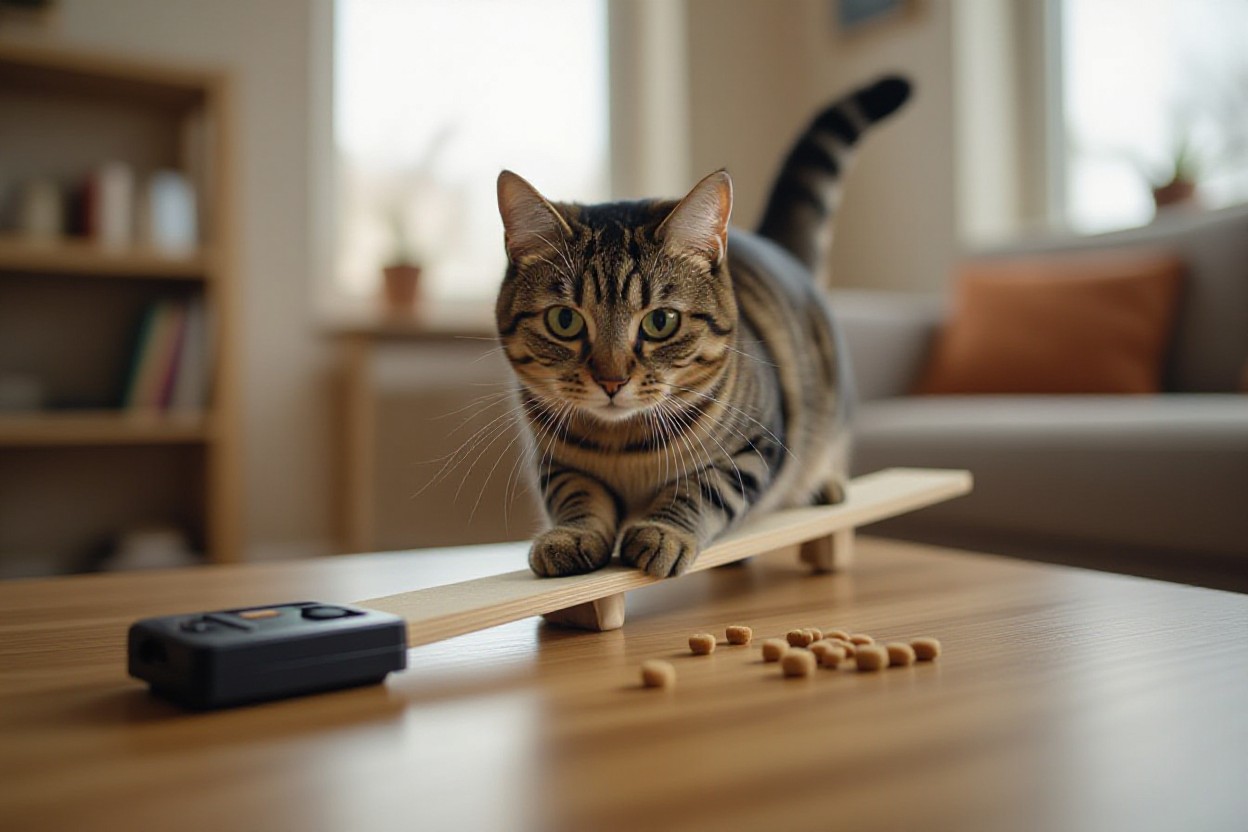
Lure your cat with a high-value treat above their nose and slowly move it back so their rear lowers; click the instant their butt touches the floor. Aim for 5–10 short reps per 3–5 minute session, 2–3 times daily. Use a clear verbal cue like “sit,” phase out the lure after 10–20 successful reps, and don’t force the position—forcing can make them avoid training.
Teaching “Stay”
Begin with a 1–2 second hold: ask for a sit, step back one foot, give the stay cue, click then treat if they hold. Progress by adding 1–2 seconds each successful trial and keep sessions under 5 minutes with 5–8 reps. Use short, frequent practice so your cat links the cue to the behavior and never punish breaks; reward releases with a release word like “free.”
To build reliability, add distance and mild distractions slowly: after 1–2 weeks of steady 5–10 second holds, back up two feet and practice with a toy or soft noise at 25% intensity. Reinforce partial success by clicking for any progress, then increase criteria—goal: 20–30 seconds in 3–6 weeks with daily short sessions. For safety, use a harness indoors if your cat panics when you step away, and always finish on a rewarded success.
Teaching “Come”
Start 1–2 meters away in a quiet room; use a distinct recall word, show a tasty treat, call your cat once, and click the moment they touch you, then reward. Run 5–10 trials per session, gradually increase distance, and practice in different rooms. Outdoors, use a secure harness and long line; never call for punishment and use a harness outdoors until recall is rock-solid.
Fun Intermediate Tricks
High-Five: Engaging Play with Your Cat
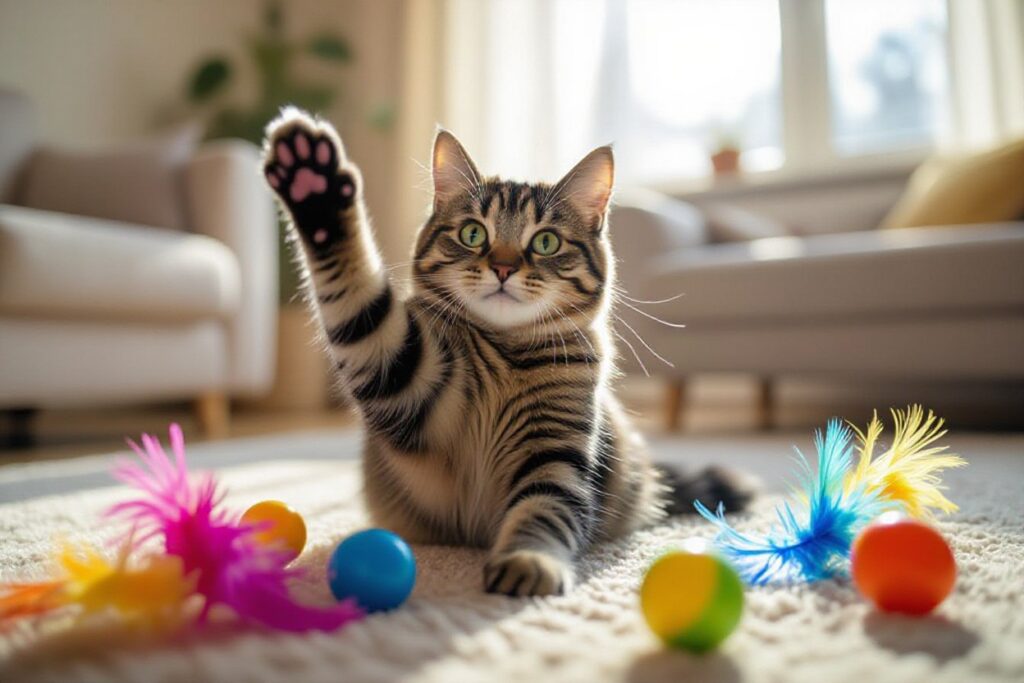
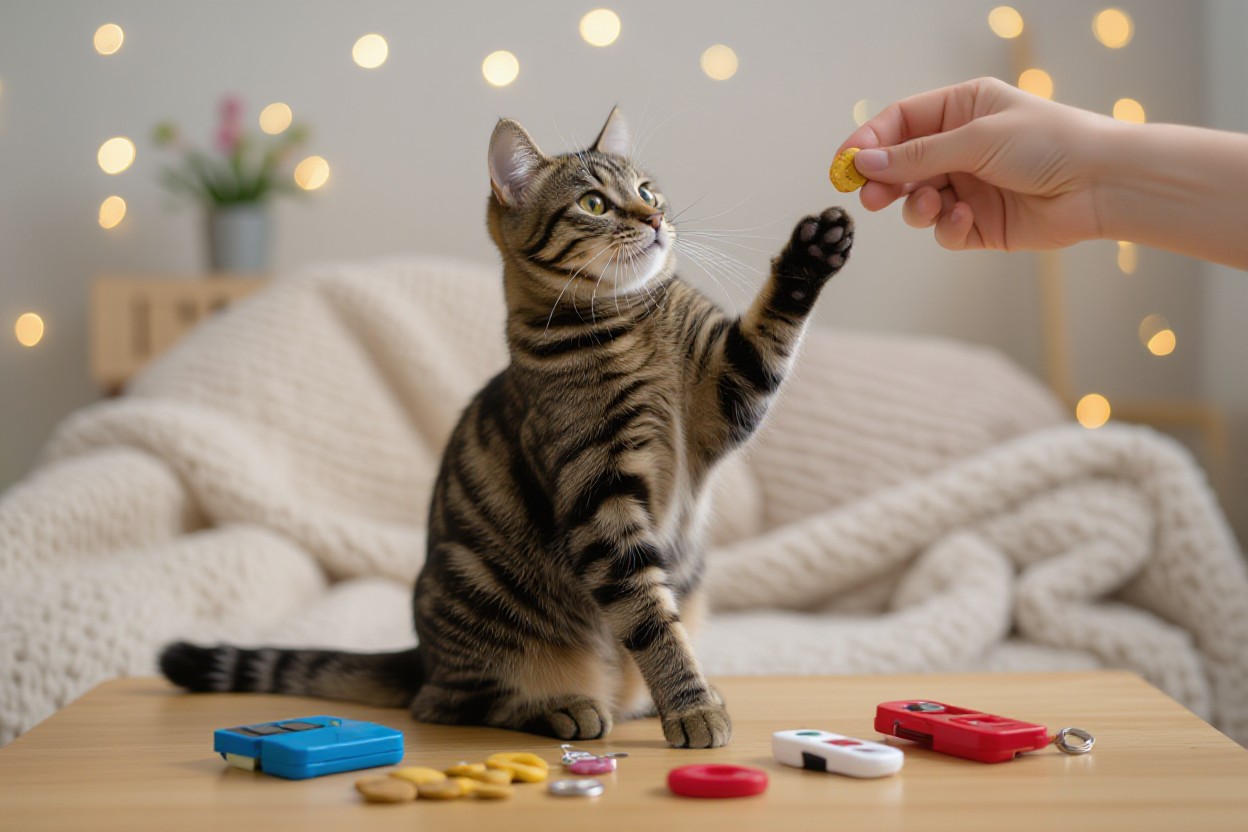
You can teach a high-five by holding a tiny treat above your cat’s paw, clicking or marking when they lift it, then shaping a flat paw touch over 5–10 short sessions of 2–4 minutes; many cats pick it up in a week. Use a consistent cue word, fade the lure, and build to a solid hand-target. Great for bonding and paw control, but do not force the paw—stop if your cat stiffens or bats aggressively.
Spin: A Whirlwind of Fun
Start by moving a treat in a tight circle near your cat’s nose so they follow it, click when they complete the rotation, and add the verbal cue “spin”; 3–7 days of 1–3 minute sessions often yields a reliable response. Vary direction to keep it engaging and use the trick to burn energy. Avoid spinning tired or older cats to prevent dizziness or stress.
Break spin into tiny steps: capture a nose-turn, then half-turns, then a full rotation, rewarding every sucessful increment and increasing criteria gradually. Try 3 sessions daily of 3–4 minutes for a week, then reduce treats to a 50% schedule while adding a hand signal; if your cat stalls, lower the criteria and reward smaller movements to rebuild momentum.
Fetch: Turning Playtime into Training
Use a toy your cat already chases, toss it 1–3 feet, and reward when they pick it up—click or praise and trade the toy for a treat to reinforce return; aim for 8–12 reps per short session. Progress distance slowly and keep sessions upbeat. Trading the toy for a treat is the fastest way to teach return; avoid small parts that could be swallowed.
To advance fetch, teach a reliable trade: offer a high-value treat the moment the toy is in mouth, then call and reward at your side. Work to 10–15 foot throws and fade food rewards to intermittent praise over 1–3 weeks. If your cat drops the toy and wanders, shorten the throw and increase treat value to rebuild motivation.
Advanced Tricks for Experienced Cats
- Jumping Through Hoops
- Ringing a Bell for Treats
- Walking on a Leash
- Distance Targeting (touch target 3–5 m away)
- Fetch with Reliable Return
- Spin-to-Down (spin then lie down on cue)
Advanced Trick Gear & Timing
| Item / Metric | Recommendation |
|---|---|
| Hoop height | Start at 6–12 in (15–30 cm) above floor, raise slowly |
| Bell type | Small, lightweight bell — test for noise sensitivity |
| Harness & leash | Escape-proof vest or H-style harness + 4–6 ft (1.2–1.8 m) leash |
| Session length | 2–5 minute micro-sessions, 3–6 times daily |
| Reps to expect | 10–30 successful reps over 2–4 weeks for reliable cueing |
| Treats | High-value small treats (~3–5 kcal each); keep fast-paced rewards |
Jumping Through Hoops
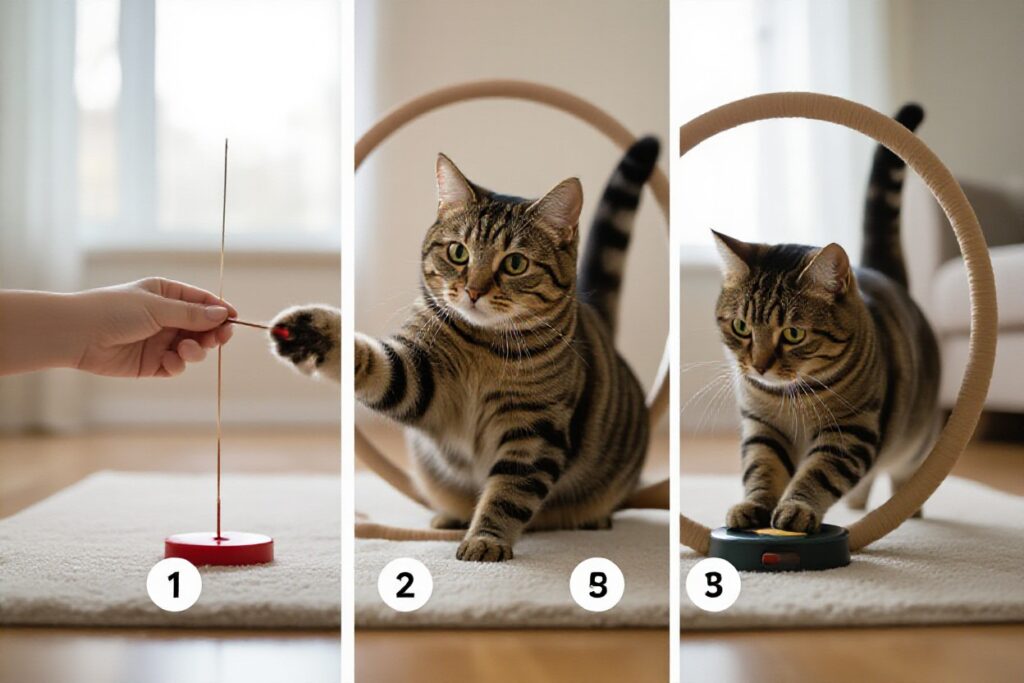
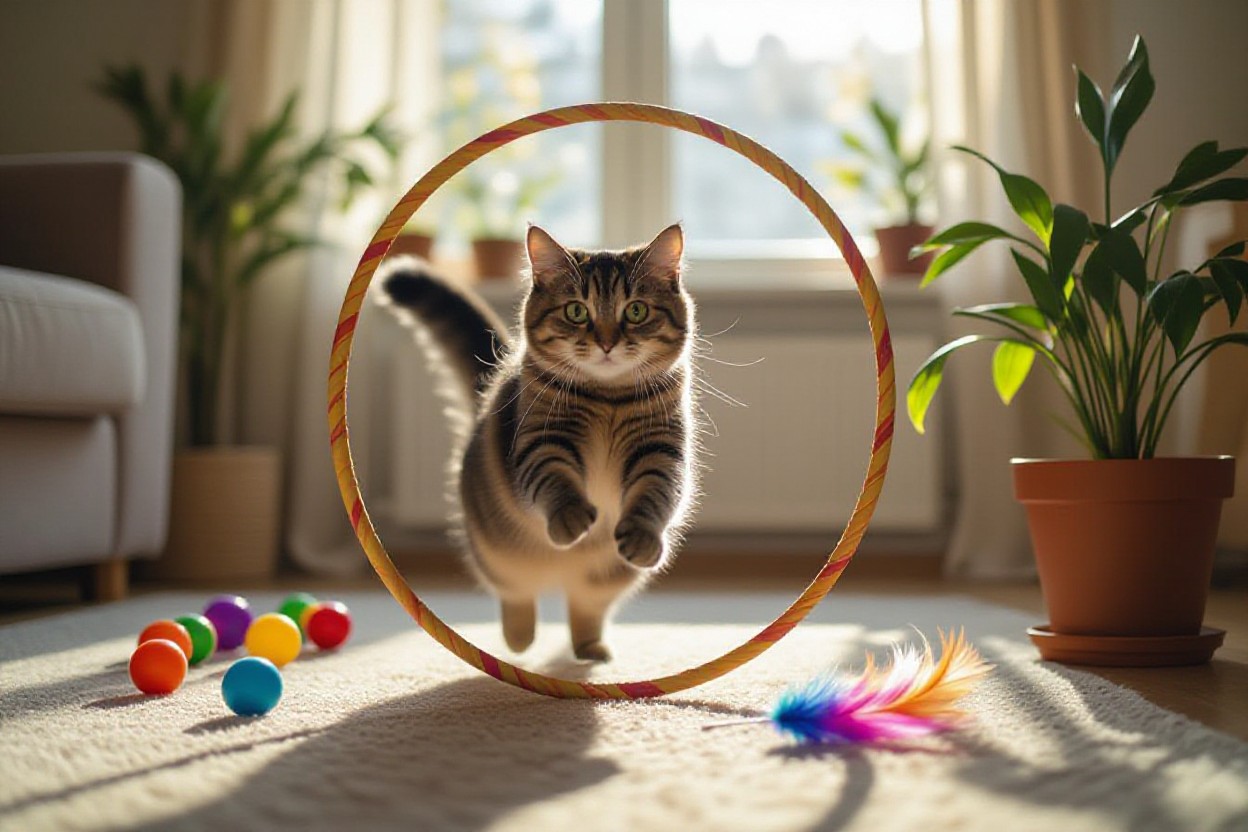
Use a hoop as a low-stress prop: start with the hoop on the floor and lure your cat with a high-value treat through the center, offering a click or marker the moment all four paws clear the rim. Train in short bursts of 3–5 minutes, aiming for 5–10 successful reps per session. Progress over 2–3 weeks by raising the hoop no more than 2–3 inches at a time; do not raise it above shoulder height to avoid strain.
Ringing a Bell for Treats
Shape bell-ringing by rewarding any touch first, then only when the bell moves. Use the clicker to mark precise moments and build from one touch to a full ring over 7–14 days. Work in 2–4 minute sessions, repeat 4–6 times daily, and keep treats small to allow many repetitions; this is one of the best fun tricks to teach your cat for clear communication.
Advance the bell by increasing the ring requirement gradually: require two touches, then a full swing, then a clear sound before you reward. Schedule a variable reward pattern once the behavior is reliable so your cat doesn’t over-request treats; for example, reward 70% of successful rings after week three. If your cat shows sensitivity, swap to a softer bell or train with a fabric tag first. Do not punish accidental pawing, and avoid loud bells for audiophobic cats.
Walking on a Leash
Fit a snug, escape-resistant harness and let your cat wear it indoors with treats for 3–7 days before adding a leash. Start with 5–10 minute indoor walks where you follow the cat’s lead, rewarding forward movement and calm stops. Use a 4–6 ft leash and keep it slack—pulling or jerking will spook your cat. Aim for 10–15 minute outdoor outings only after consistent indoor success.
Transition outdoors by choosing quiet, low-traffic areas and early mornings; perform harness-only acclimation for up to two weeks if your cat is nervous. Use high-value treats and a clicker to reinforce forward walking and recall; target sessions of 10–15 minutes, 2–4 times per week. Monitor body language—flattened ears, tail tuck, or freezing mean you should retreat and try again gradually. Also ensure your cat has an ID tag and microchip before regular outings and never use a collar-only setup for leash work—harnesses are safer.
Engaging Interactive Playtime Games
Hide and Seek: Sharpening Your Cat’s Skills
You can turn hide-and-seek into a training session by starting with 3 easy hiding spots and 5–10 minute rounds; call your cat’s name, cue “come,” then reward with 1–2 high-value treats when they find you. Use a clicker or consistent praise to mark success, and vary locations to build scent-tracking and recall. Keep sessions short and fun to prevent frustration and to maintain motivation for other fun tricks to teach your cat.
Treasure Hunt: A Fun Exploration Activity
Scatter 10–15 pieces of kibble or small treats across 4–6 safe spots (under a towel, inside a box) and cue “find it” to encourage foraging instincts; aim for 3 daily mini-sessions of 3–5 minutes. Start visibly, then increase difficulty by hiding treats deeper. Avoid small toys or human foods that pose a choking or toxicity risk, and supervise until your cat masters the game.
Progress the treasure hunt by swapping treat types—try freeze-dried chicken for high-value rewards—and by using scent trails (drag a treat wrapper) to teach tracking. Increase complexity every 3–5 sessions: add 1–2 extra hiding spots, introduce closed containers with holes, or place rewards on low shelves. Pair with clicker training to reinforce the “find it” cue; after 10–15 successful finds your cat will search faster and show improved problem-solving.
Puzzle Toys: Combining Training and Play
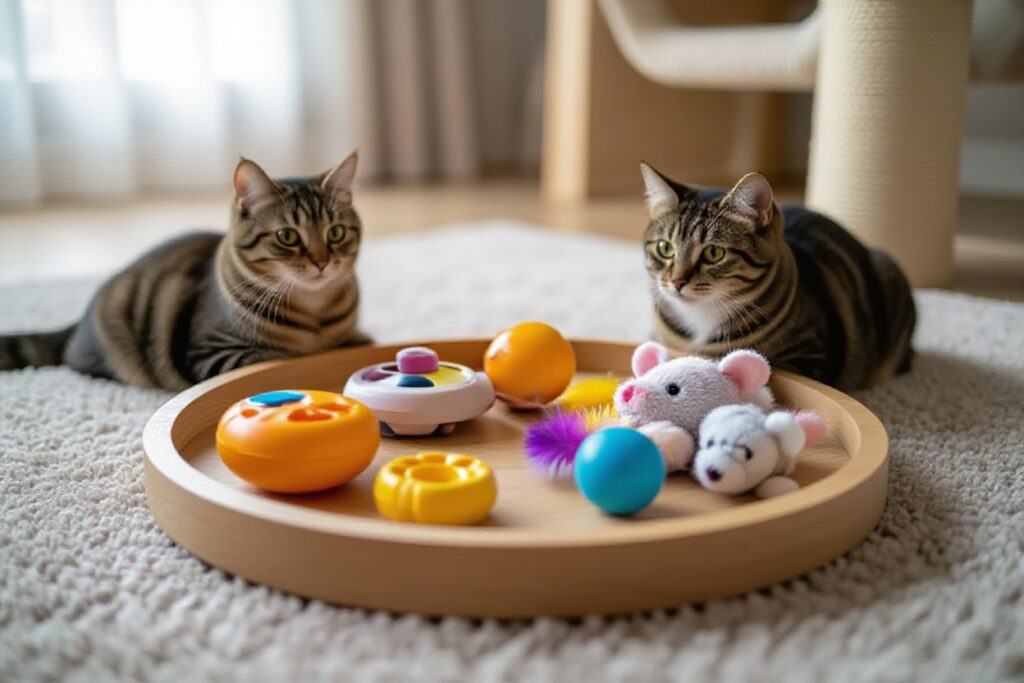
Introduce a puzzle feeder or snuffle mat for 5–15 minute sessions to combine mental exercise with food rewards; fill with 10–20 pieces of kibble so your cat practices foraging rather than overeating. Rotate toys every 1–2 weeks to keep novelty high, and use the puzzle as a reward after practicing other fun tricks to teach your cat, reinforcing both training and play. Supervise new toys to check for unsafe parts.
Start puzzles on the easiest setting: show your cat how to extract kibble, then gradually raise the difficulty over 7–10 days. Use common household solutions—like a muffin tin covered with tennis balls—to create DIY puzzles before investing in commercial toys. Track progress by logging 3–5 sessions per week; many owners see reduced boredom behaviors and improved focus within 2–3 weeks when puzzles are used alongside positive reinforcement training.
Tools and Toys to Enhance Training
Interactive Toys: Keeping Your Cat Engaged
You’ll want a mix of wand toys, feather teasers, and motorized prey simulators to vary stimulation; aim for two 10–15 minute sessions daily to match a cat’s natural hunting bursts. Wand toys and feathers let you shape behaviors like pouncing and targeting, while puzzle balls build problem-solving skills linked to fun tricks to teach your cat. Use laser pointers sparingly—overuse can frustrate—so end sessions with a tangible catch like a toy to give your cat a clear reward.
Clicker Choices: Which Is Best for You?
Pick a clicker with a consistent, sharp sound that your cat notices; basic plastic clickers cost about $2–$10, finger clickers offer portability, and free smartphone apps work in a pinch. If your cat is noise-sensitive, choose a smaller, quieter clicker or use a soft-tap finger clicker so you don’t startle them. Above all, the most important factor is consistency in the marker sound.
Consider environment and distance: loud rooms benefit from a louder clicker, while close-quarters training works fine with a soft finger clicker. You can pair a clicker with a short vocal marker like “yes” once your cat links the sound to treats, letting you phase out the device if desired. Batteries and durability matter—select a model with replaceable batteries or metal housings if you plan to train daily, and keep a spare so you don’t break session momentum.
Treat Dispensers: Reinforcement During Playtime
Use puzzle feeders, treat balls, or automatic dispensers to reward correct behaviors and extend play—these tools turn reinforcement into an extra learning step. Limit treats to about 5–10% of your cat’s daily calories and choose single-calorie kibble or tiny freeze-dried bites to avoid weight gain. Puzzle feeders also slow consumption and increase mental effort, making tricks more rewarding and durable.
Look for dispensers with adjustable difficulty: simple rolling balls suit beginners, while multi-chamber puzzles challenge experienced cats. Track treat size—most commercial treats are 1–3 kcal each, and an average indoor cat needs ~200 kcal/day, so 20 treats could add 20–60 kcal. Clean devices regularly to prevent mold, and inspect for loose parts—small, detachable pieces are a choking hazard and should be avoided.
Building a Bond Through Training
Strengthening the Human-Cat Connection
Integrating short, consistent sessions of the fun tricks to teach your cat into daily life turns training into quality time: you’ll use 3–5 minute bursts, a clicker or marker word, and high-value treats (freeze-dried chicken, 1–2 tiny pieces). Over 2–4 weeks you’ll see more eye contact and voluntary approach; one rescue cat mastered a reliable high-five in 10 days with two 5-minute sessions daily, which visibly increased trust and relaxed greetings.
Recognizing Body Language as Communication
You’ll learn to read micro-signals: a slow blink equals trust, an upright tail means curiosity, while flattened ears, hissing, or an arched, puffed tail signal fear or aggression and mean stop. Pay attention to pupil dilation and tail-tip twitching to decide whether to continue, change pace, or give space—those cues guide whether a session stays fun and productive.
Dive deeper by using context: if your cat’s tail goes from relaxed to a quick thump when you reach for a treat, pause and shift to a less invasive cue like a lure or target stick. In trials, switching from hand-fed treats to a target reduced swatting incidents by helping the cat predict your action; within 1–2 weeks many cats show fewer defensive signals. Always back off immediately at the first sign of hissing or flattened ears and rebuild with easier steps and high-value rewards.
Understanding the Value of Patience
You’ll need to accept gradual progress: most tricks take 2–6 weeks of brief daily practice, and older or anxious cats often require longer. Use tiny, frequent rewards and celebrate micro-progress—three correct repetitions in a row is a win. Patience keeps sessions positive, prevents burnout, and makes learning enjoyable for both of you.
Practice shaping behaviors by breaking tricks into the smallest steps: for a jump-through-hoop, reward looking at the hoop, then pawing, then stepping through. Transition from continuous treats to a variable schedule after reliable responses, and expect setbacks—if a cat regresses after a week away, return to prior successful steps for a few sessions. Staying calm and consistent—two 5-minute sessions daily—builds momentum far faster than long, sporadic training marathons.
Common Challenges and Solutions
Dealing with Distractions
Move training to a quiet, low-traffic room and schedule sessions when your cat is calm—often after a nap or a meal. Use 2–5 minute bursts, remove competing toys or other pets, close curtains to limit outside stimuli, and keep sessions to 3–5 repeats of a single cue. If a sudden noise interrupts, pause and wait for your cat to relax; then restart with a high-value treat to rebuild focus.
Handling Disinterest in Training
Swap treats and rewards to find what truly motivates your cat—try tiny bits of tuna, freeze-dried chicken, or a quick catnip play break, and use a clicker or animated toy if food fails. Lower the training criteria to the smallest step (one paw lift or eye contact) and reward immediately, using short sessions of 1–3 minutes so you keep things fun and bite-sized.
Run a quick preference test: offer 3 different rewards in separate trials to identify the top reinforcer, then start shaping with that item at 100% reinforcement for simple steps. Use clicker marking to make timing precise, then move to variable reinforcement (reward 100% → 60% over 2–3 weeks) as the behavior stabilizes. Also check for health issues—dental pain or sensory decline can reduce interest—so have your vet rule out medical causes before assuming stubbornness.
Preventing Frustration: Managing Expectations
Set small, measurable goals—think “5 correct reps” or “3 short sessions per day”—and accept that most cats learn tricks over weeks, not hours. Track progress with a simple checklist, celebrate tiny wins, and stop a session if your cat shows stress signals like flattening ears or tail flicks; frustration kills enthusiasm, while consistent, positive repetition builds it.
Create a realistic timeline: expect basic cues like sit or target in 1–3 weeks with 5-minute sessions, while complex behaviors (jump through hoop, reliable recall) may take 4–8 weeks. Use a training log to note session length, reward type, and success rate; aim for 80% correct responses before increasing difficulty. When progress stalls, step back two shaping levels and rebuild confidence—this keeps training fun and sustainable for both of you. Stop if you see stress signs and reset the criteria.
Incorporating Training into Daily Life
Making Training Sessions Short and Fun
Keep sessions to 3–5 minutes, 2–3 times a day, and aim for 5–8 focused repetitions per trick so your cat stays engaged. Use the clicker or a consistent word, rotate through your list of fun tricks to teach your cat, and end on a win—one jackpot treat or 1–2 extra play-chases. Small, frequent wins build momentum without fatiguing or overfeeding your cat.
Integrating Tricks into Regular Play
Add 1–2 tricks into each 10-minute play session: cue “spin” before a wand burst, ask for “sit” before a throw, or weave a hoop for a jump-through. You’ll boost mental stimulation and make training feel like enrichment rather than a chore; just avoid forcing jumps above 30 cm (12 in) to prevent injury.
Start with a 2-minute warm-up (chase or pounce), then layer a trick—cue, assist, reward—and repeat 3–6 times. Swap toys so “fetch” uses a soft ball and “jump” uses a flexible hoop; many cats learn simple cues in 7–21 days with this approach. Use kibble as low-calorie reinforcement during mealtimes to integrate training without extra treats, and track progress weekly to set realistic goals like teaching a new trick every 2–3 weeks.
Rewarding Good Behavior Throughout the Day
Offer tiny, frequent rewards—kibble, a 1–3 kcal treat, or 10–30 seconds of interactive play—when your cat offers desired behaviors outside formal sessions. Switch from continuous rewards to a partial schedule after initial learning to strengthen reliability; for example, reward every time for 7–10 days, then move to a 1-in-2 pattern. Always pair praise or play with food to reinforce connections.
Use an intermittent schedule: start with 100% reinforcement, then transition to variable rewards to increase persistence. For exceptional responses, give a “jackpot” of 3–5 small treats plus extra play. Keep treats to no more than 10% of daily calories (about 20 kcal if your cat’s target is 200 kcal/day) and never offer toxic human foods like onion or chocolate. Combining food, play, and affection lets you reward the behaviors you want while protecting your cat’s health.
Monitoring Progress and Adjustments
Tracking Your Cat’s Learning Journey
Keep a simple log with dates, trick name, number of successful reps, and which reward worked best; aim for 5–10 minute sessions, 2–3 times daily. Note patterns—after ~20–30 repetitions many cats show consistent responses—so mark when a cue reaches ~80% reliability. Using this data helps you spot plateaus, tailor the next steps, and measure progress for each of the fun tricks to teach your cat.
Adjusting Techniques Based on Your Cat’s Response
Watch body language closely and adapt if your cat shows stress signals like flattened ears, dilated pupils, or hissing; shorten sessions, lower difficulty, or swap treats. If a trick stalls after 8–10 short sessions, break it into micro-steps, change the lure or timing, or try a clicker instead of verbal cues to improve precision.
For example, if your cat freezes when asked to jump through a hoop, start by rewarding approach, then touching the hoop, then stepping through—each step should reach 5–10 reliable reps before progressing. Use variable reinforcement once a trick hits ~80% success: give a jackpot reward every 4–6th correct response to boost motivation. Also consider environment tweaks—quieter room, raised platform, or different time of day—because many cats perform better at consistent times; reduce treat dependence by decreasing portions by ~50% over two weeks and substituting praise or play.
Celebrating Small Victories
Mark tiny wins—first touch, first sit, three consecutive high-fives—with enthusiastic praise, a favorite bite, or a brief play session; these micro-celebrations reinforce progress and keep training fun. Logging each small milestone makes long-term goals, like mastering 10–12 tricks, feel achievable and encourages you to keep consistent sessions.
Set clear mini-milestones such as “10 successful sits” or “three fetched toys in a row,” then reward with a larger treat or extra playtime to cement the behavior. Many owners report teaching basic tricks in 2–6 weeks by celebrating incremental gains and using a simple chart or photo series to track improvement. Avoid pushing when progress stalls—celebration paired with sensible adjustments sustains momentum and strengthens your bond.
Summing up
Presently you can bring cat training basics together—clicker work, positive reinforcement, short sessions—and make learning enjoyable; these fun tricks to teach your cat, like sit, high-five, come, fetch, spin and hoop jump, fit into a sensible timeline with tasty rewards and patience, helping your cat’s mental health, strengthening your bond, and turning training into interactive playtime.
FAQ
Q: How do I get started with fun tricks to teach your cat for interactive playtime?
A: Start with short, consistent sessions (3–5 minutes, 2–3 times daily) in a quiet room. Use positive reinforcement: high-value treats, praise, and a clicker or a clear verbal marker like “yes” to mark the exact moment your cat does the desired behavior. Break each trick into tiny steps (lure, reward, fade the lure), train one trick at a time, and keep criteria low at first so your cat succeeds often. Kittens often learn faster, but adult cats can learn just as well with patience; expect 1–2 weeks for simple cues (sit, come) and several weeks for more complex tricks. Consistency, low-distraction environments, and short, frequent play-focused sessions make fun tricks to teach your cat approachable and enjoyable for both of you.
Q: What are 10–12 easy fun tricks to teach your cat and how do I teach them?
A: Try these beginner-to-intermediate tricks: 1) Sit — hold a treat above the head so the cat sits; mark and reward. 2) High-five — present your palm and reward when the paw touches it. 3) Come (recall) — use a food reward or favorite toy, call name + cue, reward at the cat, not the bowl. 4) Fetch — toss a small toy, reward returns with play or treat. 5) Spin — lure around in a circle then add a cue. 6) Jump through hoop — start low, lure through, raise slowly. 7) Target touch — teach touching a target stick; use for directing movement. 8) Stand up — lure chest-up and mark. 9) Wave — shape from high-five into brief paw lift. 10) Tunnel/crawl — lure through a tunnel for agility play. 11) Roll over (advanced) — reward incremental belly rolls. 12) Touch bell or place paw on mat — use shaping and clicker. Most simple tricks take days to a couple of weeks; intermediate ones take several weeks of short daily sessions. Reward immediately, fade lures, and add verbal cues once the motion is reliable.
Q: My cat seems stubborn or uninterested — how can I troubleshoot and what treats work best?
A: First check motivation: train when your cat is mildly hungry and pick high-value rewards (shredded cooked chicken, tuna, or freeze-dried meat treats). If food fails, try play rewards (chase a wand) or praise. Lower the training criteria into very small steps so the cat can succeed frequently, increase reinforcement rate, shorten sessions, and vary rewards to prevent boredom. Avoid force or punishment; that shuts down learning. If progress stalls, try a new environment, switch to an odor-rich treat, or consult a vet to rule out health issues. Benefits of these fun tricks to teach your cat include better mental stimulation, reduced problem behaviors, improved confidence, and stronger bonding — small, consistent adjustments usually overcome stubbornness and keep training fun for both of you.