There’s a straightforward, humane approach to teaching your cat basic commands that keeps training effective and safe. You will learn short sessions, reward-based steps, and consistency and patience to shape sits, recalls, and targeting; always avoid force or punishment to prevent stress, bites, or scratches. With proper timing and clear cues you can build a strong bond and reliable responses while protecting your cat’s welfare and your safety.
Understanding Your Cat
You already observe subtle signals-ear position, tail flicks, and pupil dilation-that tell you when your cat is stressed or engaged. Short sessions under 10 minutes align with a typical feline attention span, while kittens under 6 months often pick up cues faster. A soft voice and high-value treats improve response rates, and pausing when your cat hisses prevents trust erosion.
Factors to Consider When Training
You must weigh your cat’s age, medical status, and past experiences before starting drills; seniors with joint pain need slower pacing, and shy cats require longer socialization. Environmental consistency-quiet rooms and minimal foot traffic-improves focus, and aligning rewards with preferences boosts motivation. Knowing how these elements interact lets you tailor sessions for safety and success.
- Age
- Health
- Environment
- Motivation
- Temperament
Tips for Building a Strong Bond
You can strengthen trust with predictable routines: schedule feeding, offer two 10-15 minute interactive play sessions daily, and groom gently 2-3 times per week to increase handling tolerance. Use slow blinks and a calm tone, reward calm behavior immediately, and avoid forcing proximity after warning signs. This steady, respectful approach increases your cat’s willingness to participate in training.
- Play
- Routine
- Grooming
- Rewards
- Gentle touch
You should rotate activities-wand toys that mimic prey, short target-training drills, and puzzle feeders-to prevent boredom; break treats into pea-sized pieces so you don’t exceed daily calories during training. Start with 2-3 minute interactions and add 30-60 seconds each week as focus improves, using a clicker or consistent sound to mark successes. This incremental method reduces stress and builds reliable responses.
- Wand toys
- Puzzle feeders
- Clicker
- Small treats
- Gradual increase
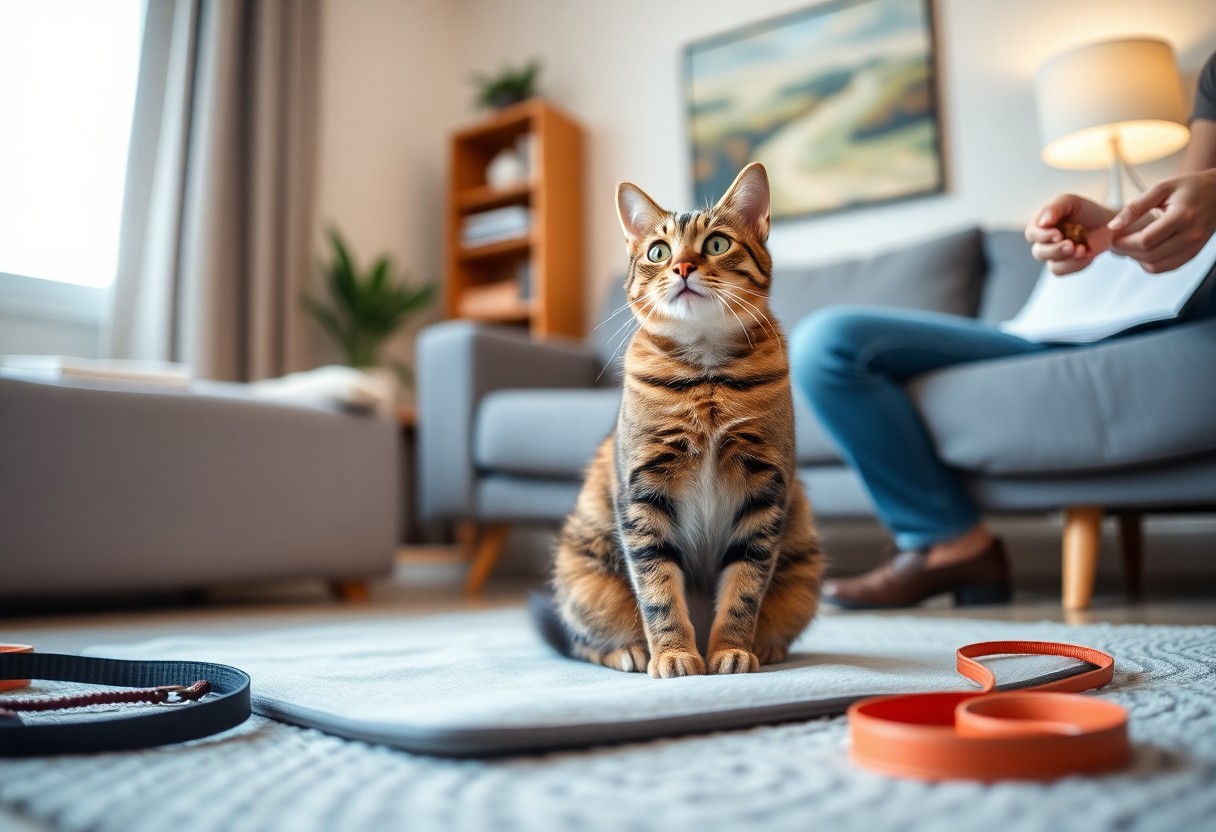
Basic Commands to Teach Your Cat
Focus on a few high-impact behaviors and teach them with 3-5 minute sessions, 2-3 times daily, using high-value treats and a clicker or marker word. You should aim for 5-10 repetitions per session and track progress in a notebook: note date, environment, and success rate to spot patterns. Avoid aversive methods; using gentle shaping increases response rates and builds trust, often yielding reliable results within 2-6 weeks with consistent practice.
Sit
Use a treat held just above your cat’s nose and slowly move it back over the head; when the cat drops into a sit, say “sit” and give the treat immediately. You should do 5-10 short reps per session, pairing with a click or soft marker on the exact moment of sitting. Many cats will start showing voluntary sits within 3-10 sessions; if not, try using a target stick to guide the motion and keep rewards high-value.
Come
Begin recall at 1-2 feet in a quiet room: call your cat’s name plus a cue like “come,” crouch, and show a very enticing treat; reward on arrival every time at first. Conduct 10-15 short repetitions per session and gradually increase distance to 5-10 feet. Avoid chasing your cat to force return since that reinforces fleeing behavior-never chase as a training tactic.
To generalize recall, practice in multiple rooms and add mild distractions (toys, another person) once indoor reliability hits ~80%. Gradually space rewards on a variable schedule (start FR1, shift to VR2-4) to build persistence. When training outdoors, always use a harness and long line until your cat returns reliably at 10+ meters; this prevents dangerous escapes and teaches you control in real environments.
Effective Training Techniques
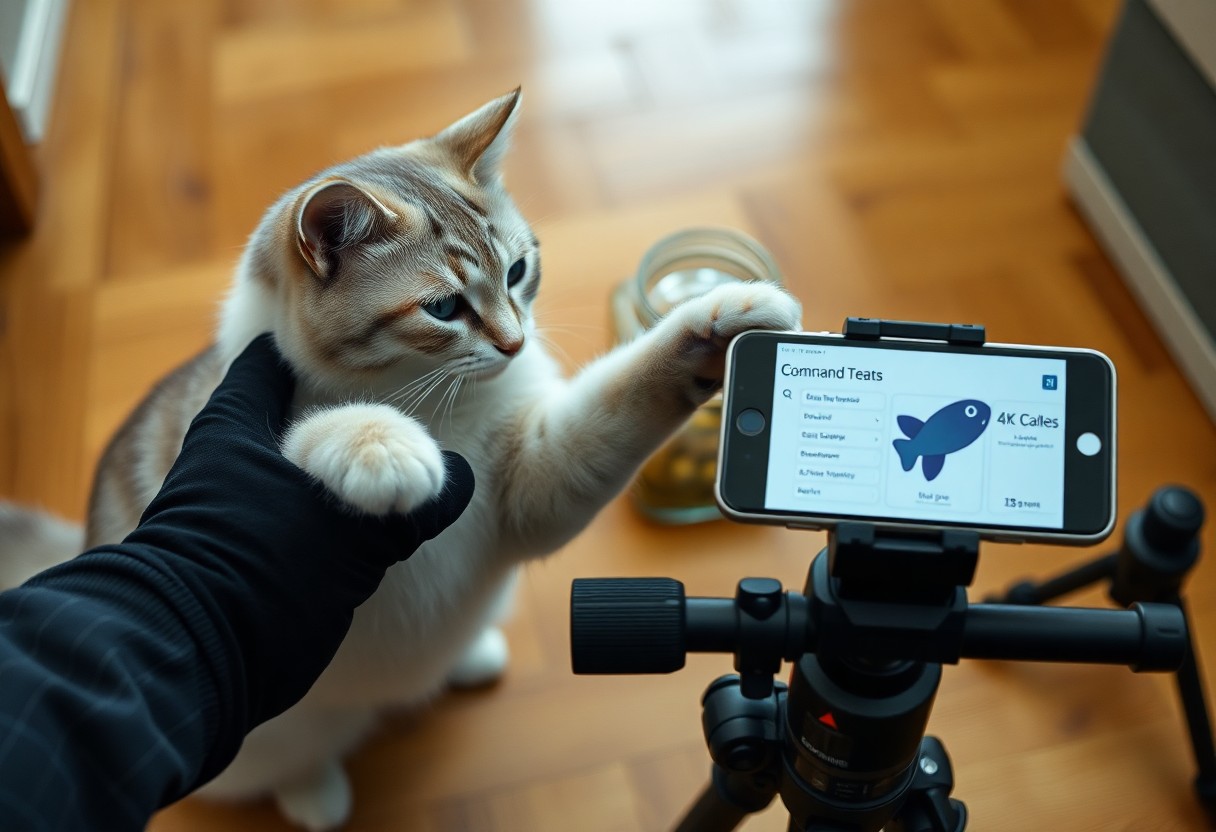
Focus on bite-sized practice: train in 3-5 minute sessions, 2-4 times daily, and aim for 10-20 repetitions per cue each day. Mix clicker or verbal markers with a tiny, high-value treat (think tuna or soft chicken), and mark the exact moment of correct behavior-ideally within 1 second. Avoid force or scolding; that shuts down learning and increases stress.
Positive Reinforcement
Favor rewards over corrections by pairing a clear marker (click or short word) with a reward every time at first, then phase to intermittent reinforcement at 50-80% to maintain behavior. Offer 1-2 calorie-sized treats per repetition or a 1-2 second play burst for play-motivated cats. Many owners report measurable gains within 10-14 focused sessions when using consistent, high-value rewards.
Consistency and Patience
Set the same cue words and hand signals and train at the same times each day so your cat builds pattern recognition; inconsistent cues slow progress. Expect gradual gains-most cats need 2-6 weeks for a reliable response-and avoid repeating commands more than 3 times per trial to prevent confusion. Keep sessions calm and end on a positive note.
When you deepen consistency, structure progression: use continuous reinforcement for 7-14 days, then shift to variable schedules (reward 50-80% of correct responses) to strengthen retention. Track progress with a simple log-date, session length, success rate-and adjust rewards when success exceeds 80% by increasing difficulty (distance, duration, or distraction). If regression appears during stress or illness, reduce demands and return to frequent, small rewards until stability returns.
Troubleshooting Common Challenges
When training stalls after 7-14 days, change one variable at a time: shorten sessions to 3-5 minutes, swap treats for high-value rewards like small pieces of cooked chicken, or switch to a clicker for clearer timing. If your cat regresses around guests or mealtimes, track sessions per day and keep a training log for 2 weeks to spot patterns. Avoid scolding – punishment increases fear and reduces learning, so focus on positive adjustments and consistent repetition.
Behavioral Issues
If your cat displays biting, scratching, or avoidance during training, assume stress or overstimulation rather than willful disobedience. Pause when your cat swipes, give a 30-60 second break, then resume with a simpler cue achieved in 1-2 steps. For redirected aggression, separate pets for 10-15 minutes and use play to dissipate energy; for anxiety-linked refusal, pair the cue with brief sessions of 3-4 minutes and very high-value treats until confidence builds.
Overcoming Distractions
Start training in the quietest room with no windows open, limiting sessions to 3-5 minutes and 2-3 times daily; that reduces competing stimuli while you establish the behavior. Use a treat delivered within 1 second of the desired response and gradually introduce low-level distractions (soft TV, another person across the room) only after you see 8 out of 10 successful repetitions in the calm environment.
Progressive desensitization works best: create a three-step plan over 10-14 days – step 1: 5 days at baseline (quiet, 80-90% success); step 2: add one mild distraction for 3-4 days, require 80% success before advancing; step 3: increase distraction intensity or distance. Alternate food rewards with 30-second play sessions and log successes to know when to raise difficulty. Emphasize consistency and immediate reinforcement throughout.
Gradually Increasing Complexity
After your cat reliably performs basic cues at home, increase difficulty by layering variables: add distance, longer duration, background noise, and other animals. Move in small steps – change only one factor every 2-3 sessions and aim for 80-90% success before progressing. Keep sessions to 5-10 minutes, 3-4 times daily, and log results so you can spot plateaus. If accuracy falls, simplify the task and reward immediately to rebuild confidence.
Advanced Commands
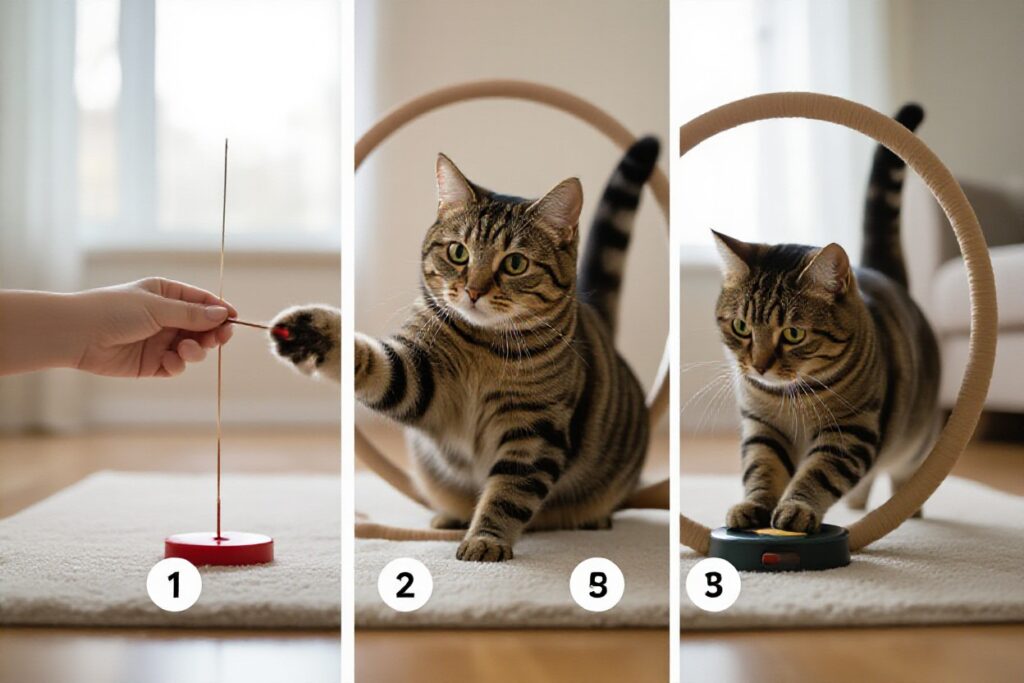
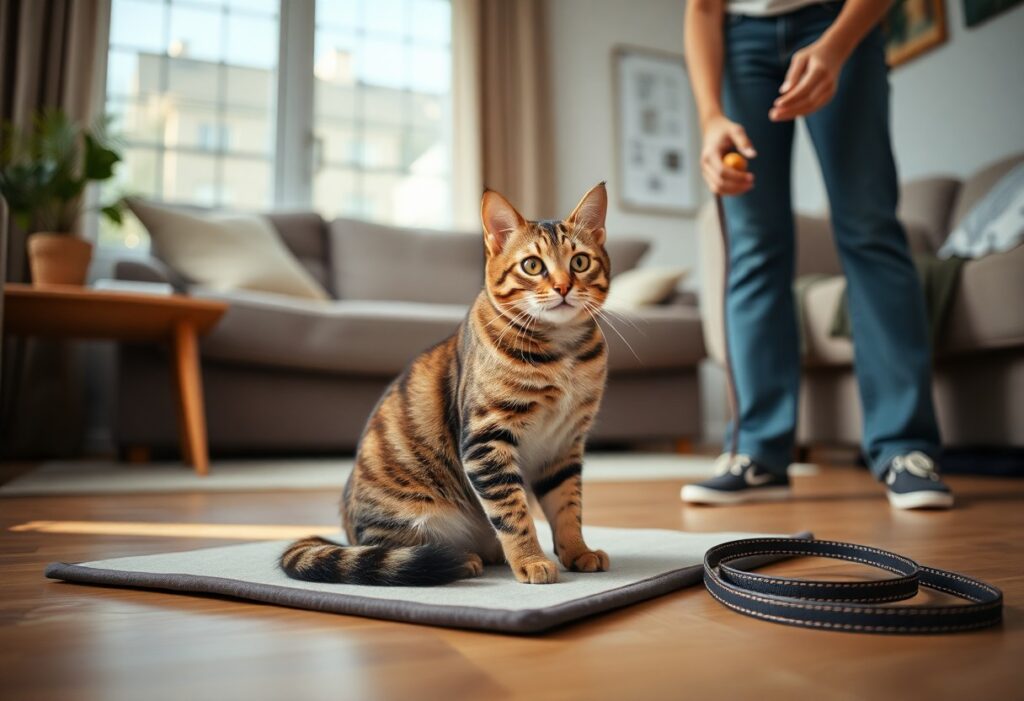
You teach advanced commands like “target,” “go to mat,” and “heel” by shaping behavior into 3-5 incremental milestones and using a clear marker. Require 3-5 consecutive correct responses before raising criteria, and employ high-value treats until the cat is reliably performing under mild distractions. Trainers report many cats master a new complex cue within 8-12 short sessions when criteria are consistent and reinforcement is timely.
- Targeting
Goal Progression: start with nose-to-stick, then distance to 1-2 m, then stationary target holds - Distance & Duration
Goal Progression: increase distance by 0.5-1 m and duration by 2-5 seconds per reliable step; use variable rewards at 60-80% - Distraction Proofing
Goal Progression: introduce one new distraction type (noise, toy, person) per 2-3 sessions; if performance drops, step back
Tricks and Agility
Start tricks and agility with low-risk elements: jumps at 10-15 cm, short tunnels, and simple spins. Train in short bursts (3-5 minutes), 2-4 times daily, increasing obstacle height or complexity by no more than 5 cm or one element per week. Use a clicker or fast marker and reward within 1 second of the correct response. Prioritize soft landings and non-slip surfaces to keep your cat safe.
Build a 4-week mini-plan: Week 1 focus on targeting and two simple tricks (spin, high-five) with 10-15 reps per session; Week 2 add a 10-15 cm jump and tunnel, practicing 5-7 runs each session; Week 3 combine sequences (target → jump → mat) and shorten treats to a variable schedule; Week 4 run a short course of 3-5 obstacles at reduced speed, aiming for consistent fluidity. If your cat hesitates, reduce height or simplify the sequence and reward small approximations to maintain positive momentum.
Tips for Ongoing Training
Keep ongoing training manageable with short, frequent sessions-aim for 3-5 minutes, 2-4 times daily-and use positive reinforcement like cooked chicken or high-value treats. Change context often (different rooms, mild distractions) so your cat generalizes commands; use a clicker or consistent marker within 0.5 seconds to speed learning. Log success rates (for example, 8/10 trials) to adjust rewards and difficulty. Any progress you make should be rewarded immediately to solidify the behavior.
- Consistency: practice same cue words and signals every time.
- Keep a short training log: note sessions, success rates, and preferred rewards.
- Prioritize gentle handling and stop if your cat shows stress signals.
Regular Practice
Stick to a predictable schedule so your cat develops expectation: try 5 minutes, three times daily, or two 7-minute sessions during peak alert periods (morning and evening). Rotate commands-sit, target, recall-so each skill gets 10-20 short repetitions per week. Track a simple metric (e.g., success in 7 of 10 trials) to decide when to reduce reward frequency and move to maintenance.
Keeping Sessions Short and Fun
Limit sessions to 3-7 minutes to match feline attention spans and alternate rewards-treat, play, praise-to prevent boredom; for example, use a wand toy after two successful recalls. End on a clear success so your cat leaves the session feeling accomplished, and introduce mild novelty (different treats or a new toy) every 3-5 sessions to sustain interest.
Use varied reinforcers: offer freeze-dried fish one day, a high-value commercial treat the next, and an intense 30-second play burst as a reward occasionally-trainer experience shows this raises engagement and response rates. Schedule training during active windows and avoid sessions right after meals when motivation drops.
Conclusion
Ultimately you can teach your cat basic commands by using consistent cues, short training sessions, and high-value rewards; you must time reinforcement precisely, shape behaviors gradually, and stay patient while adapting methods to your cat’s personality. With regular practice and clear expectations, you will build reliable responses and strengthen your bond without force.
FAQ
Q: What basic commands should I teach my cat first and how do I begin?
A: Start with simple, high-value commands: “come,” “sit,” and “stay.” Begin in a quiet room with minimal distractions and short 2-5 minute sessions, 2-3 times daily. For “sit,” hold a small treat above the cat’s nose and move it slowly over the head so the cat naturally sits; mark the moment of the sit (clicker or a consistent word like “yes”) and give the treat, then add the verbal cue. For “come,” use an excited voice, crouch to appear inviting, say the cat’s name and the cue, and reward immediately when the cat approaches. For “stay,” ask for a sit, show an open palm as the stay signal, take one small step back, mark and reward if the cat holds position, then increase distance and duration gradually. End each session on a successful, easy repetition so the cat finishes motivated.
Q: How should I use treats, clickers, and timing to teach commands effectively?
A: Use high-value, small treats that the cat will work for and keep portions tiny to avoid overfeeding. Clicker training requires precise timing: click the instant the desired behavior occurs, then deliver a treat within one second so the cat links the click to the reward. If you don’t use a clicker, use a short, consistent marker word (e.g., “yes”). Start with continuous reinforcement (reward every correct response), then transition to a variable schedule (every 2-4th response) to strengthen reliability. Pair treats with play and praise to diversify reinforcement. Always reward immediately for the specific behavior you asked for and keep sessions brief to maintain focus.
Q: What if my cat ignores commands or gets distracted – how do I troubleshoot?
A: First rule out medical or stress-related issues if the cat’s behavior suddenly changes. Increase motivation by training before meals or using especially tasty treats and short play bursts as rewards. Reduce distractions and train in progressively more challenging environments only after the cat is reliable at lower difficulty. Break behaviors into smaller steps (shaping): reward approximations of the target behavior and raise criteria slowly. Use the cat’s name before the cue to gain attention, keep sessions consistent and frequent, and avoid scolding; punishment creates avoidance and reduces learning. If progress stalls, lower the difficulty, shorten sessions, and rebuild momentum with high success rates and rewards.